
Introduction
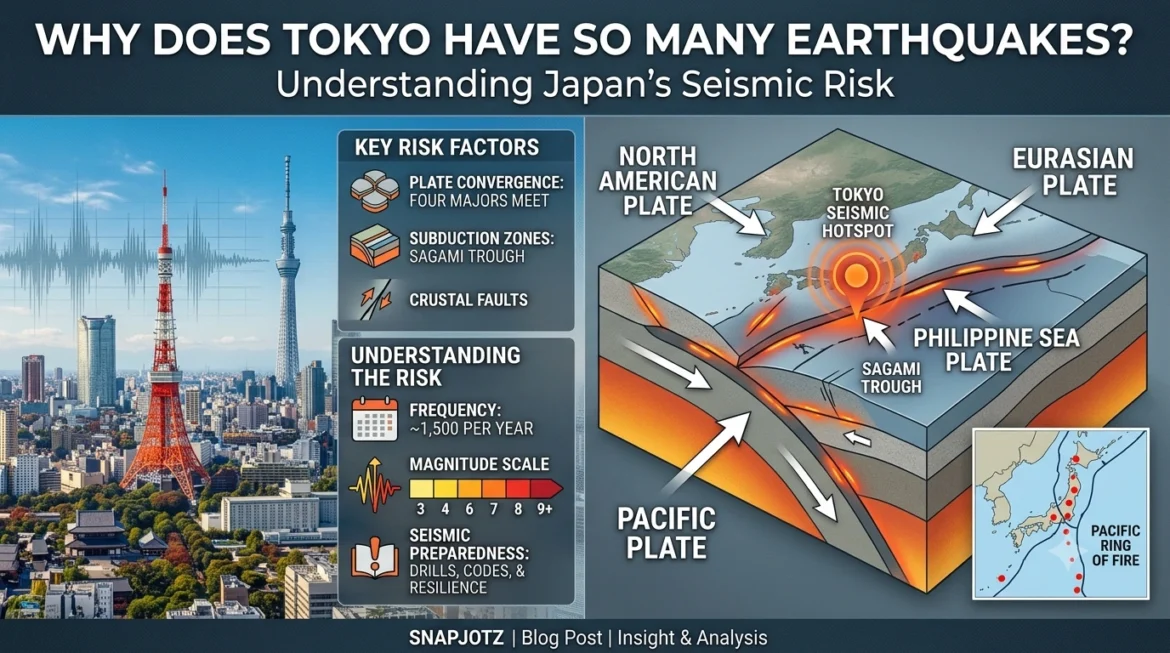
If you have ever wondered why Tokyo experiences so many earthquakes, the answer lies beneath the city. Tokyo sits within one of the most complicated tectonic environments on Earth, where several major plates interact and oceanic plates descend beneath land plates.
Japan’s location makes earthquakes a natural part of the country’s geological environment. Around Tokyo, the situation is particularly complex because the Philippine Sea Plate and Pacific Plate interact beneath the broader Kanto region, creating several possible sources of earthquakes.
The risk is not simply about how often earthquakes happen. Tokyo is also one of the world’s largest metropolitan areas, so even a moderate or shallow earthquake can create significant disruption.
This guide explains why Tokyo has so many earthquakes, how the surrounding tectonic plates work, what types of earthquakes can affect the city, and how Tokyo prepares for them.
Why Does Tokyo Have So Many Earthquakes?
Tokyo has frequent earthquakes because it lies in a highly complex plate-interaction zone where multiple tectonic plates meet and subduct beneath one another.
Japan is surrounded by several tectonic plates, including the Pacific Plate, Philippine Sea Plate, North American Plate and Eurasian Plate in the conventional regional model used by Japanese authorities. These plates move slowly, but their movement generates enormous stresses in Earth’s crust.
Tokyo is particularly exposed because the Kanto region contains a complicated system of interacting plates and subduction zones.
The Tokyo Metropolitan Government describes southern Kanto as an especially earthquake-prone region because plates meet beneath the area.
Japan Sits in a Major Earthquake Zone
Japan’s geography is one of the biggest reasons earthquakes are so common.
The Japan Meteorological Agency explains that the Pacific Plate and Philippine Sea Plate move toward Japan and subduct beneath land plates at rates of several centimetres per year. This creates complex stresses around the Japanese archipelago.
A simple way to understand the process is:
Moving plates → friction and stress → accumulated strain → sudden movement → earthquake
The plates do not move smoothly everywhere. Friction can lock sections of the boundary, allowing stress to build. When rocks eventually slip or rupture, energy is released as seismic waves.
What Tectonic Plates Are Near Tokyo?
Tokyo’s underground structure is unusually complicated.
The Tokyo Metropolitan Government’s disaster information explains that the Philippine Sea Plate subducts beneath the North American Plate from the south, while the Pacific Plate subducts from the east beneath the plates above it.
Researchers at the University of Tokyo similarly describe the Tokyo metropolitan area as being affected by the interaction of the Philippine Sea and Pacific slabs beneath the region.
The major plates involved include:
| Plate | Role around Japan/Tokyo |
|---|---|
| Pacific Plate | Subducts beneath the region from the east |
| Philippine Sea Plate | Subducts beneath southern Kanto |
| North American/Okhotsk Plate | Common regional model for the plate underlying northern Japan and Tokyo |
| Eurasian Plate | Part of the broader tectonic system around Japan |
Different scientific models sometimes use different names or boundaries for the continental plates around Japan, so simplified maps can look slightly different.
The important point is that Tokyo sits above a complicated system of interacting plates and slabs, rather than a single simple fault line.
The Role of the Sagami Trough
One of the most important geological features for understanding Tokyo’s earthquake risk is the Sagami Trough.
The Sagami Trough extends from Sagami Bay toward the area southeast of the Boso Peninsula. The Philippine Sea Plate is subducting beneath the land plate along this system.
This matters because plate boundaries can accumulate strain.
When the boundary eventually slips, a large earthquake can occur.
Historical earthquakes associated with this system include the 1923 Great Kanto Earthquake, which caused catastrophic destruction across the Tokyo and surrounding region.
The Sagami Trough therefore remains an important part of long-term earthquake risk assessments for southern Kanto.
What Is a Subduction-Zone Earthquake?
A subduction-zone earthquake occurs when one tectonic plate moves beneath another.
In Japan, oceanic plates such as the Pacific Plate and Philippine Sea Plate are pushed beneath landward plates. The boundaries can become locked because of friction.
As movement continues, stress accumulates.
Eventually, the locked section can rupture, releasing the stored energy as an earthquake.
The Japan Meteorological Agency explains that earthquakes around Japan are strongly associated with the subduction of the Pacific and Philippine Sea plates.
This is one reason Japan experiences both frequent earthquakes and occasional very large earthquakes.
Tokyo Can Also Experience Earthquakes Beneath the City
Not every earthquake affecting Tokyo occurs at a major plate boundary.
The Tokyo Metropolitan Government identifies several possible earthquake sources in the southern Kanto region, including:
- Shallow earthquakes in the Earth’s crust
- Earthquakes along the Philippine Sea Plate–North American Plate boundary
- Earthquakes occurring within the Philippine Sea Plate
- Earthquakes along the Philippine Sea Plate–Pacific Plate boundary
- Earthquakes occurring within the Pacific Plate
- Earthquakes associated with the complicated area where the plates interact
This is why simply looking at a map of surface faults does not provide the complete picture of Tokyo’s earthquake risk.
Some potentially damaging earthquakes can originate inside a subducting plate beneath the region.
What Is a Tokyo Directly Beneath-the-City Earthquake?
You may see the term “Tokyo earthquake” used in news reports or preparedness discussions.
A directly beneath-the-city earthquake generally refers to an earthquake occurring close enough beneath the metropolitan region to produce strong local shaking.
These earthquakes can be particularly concerning because the distance between the source and populated areas can be relatively small.
The Tokyo Metropolitan Government notes that shallow inland earthquakes can cause severe local shaking even when their overall magnitude is smaller than that of a giant offshore earthquake.
That distinction is important.
Magnitude is not the only factor that determines damage.
Depth, distance from populated areas, ground conditions, building quality and the duration and characteristics of shaking all matter.
Why Shallow Earthquakes Can Be More Dangerous
Imagine two earthquakes with similar energy release.
If one happens deep underground and far from a city while another occurs relatively close to the surface beneath a densely populated area, their effects can be very different.
A shallow earthquake close to Tokyo can produce intense local shaking.
That is why earthquake scientists and disaster planners consider more than magnitude alone.
The Tokyo government specifically warns that shallow inland earthquakes can produce significant damage when their source is beneath an urban area.
Tokyo’s Ground Conditions Also Matter
Another part of earthquake risk is what lies beneath the buildings.
Different types of soil and geological material can respond differently to seismic waves. Soft ground can amplify certain types of shaking, increasing the challenge for structures and infrastructure.
This is one reason earthquake risk can vary considerably between different parts of a metropolitan region.
A city-wide earthquake does not necessarily mean every neighborhood experiences identical shaking.
Why Tokyo’s Huge Population Makes Earthquakes More Serious
Tokyo’s earthquake risk is not only geological.
It is also urban.
Tokyo is an enormous metropolitan area containing:
- Dense residential neighborhoods
- High-rise buildings
- Rail networks
- Roads and expressways
- Hospitals
- Schools
- Utility infrastructure
- Commercial districts
- Underground transportation
- Large numbers of commuters
An earthquake can therefore create secondary problems even when buildings remain standing.
For example, disrupted rail services can leave commuters unable to return home, while damaged roads can slow emergency response.
Tokyo’s disaster planning specifically considers transportation, lifelines, evacuation and people who may be unable to return home after a major earthquake.
What Happened During the Recent Tokyo-Region Earthquake?
The subject has received renewed attention following a magnitude 5.9 earthquake in eastern Japan on August 23, 2026, according to the Japan Meteorological Agency’s preliminary measurement reported by the Associated Press.
The earthquake occurred in southern Ibaraki Prefecture at a depth of about 70 kilometres and was strongly felt in Tokyo and neighboring prefectures. At least 37 people were reported injured across five prefectures, mostly with minor injuries. No tsunami warning was issued.
The event is useful as a reminder of the region’s seismic environment, but it should not be interpreted as proof that a larger earthquake is about to occur.
Earthquakes cannot currently be predicted with that level of precision.
Does a Tokyo Earthquake Mean a Bigger Earthquake Is Coming?
No. A single earthquake does not reliably mean that a larger earthquake is about to happen.
Aftershocks can occur after earthquakes, and scientists monitor seismic activity closely, but there is no scientifically reliable method for predicting the exact time, location and magnitude of a future earthquake.
This distinction is especially important when reading social media posts or sensational headlines about earthquakes in Japan.
A responsible approach is to focus on preparedness rather than prediction.
How Often Does Tokyo Have Earthquakes?
Tokyo and the wider Kanto region experience earthquakes of different sizes relatively frequently.
Many are too small to cause noticeable damage, while larger earthquakes can be felt across broad areas.
The reason for this frequency is the region’s complex tectonic setting. The Japan Meteorological Agency describes Japan as one of the world’s major earthquake-prone regions because multiple plates interact around the country.
So when people ask, “Why does Tokyo have so many earthquakes?”, the answer isn’t that one particular fault constantly produces earthquakes.
Instead, Tokyo is affected by multiple possible earthquake sources within a complicated plate system.
How Japan Prepares for Earthquakes
Japan has invested heavily in earthquake preparedness because earthquakes are a known part of its natural environment.
Measures include:
- Earthquake-resistant building standards
- Emergency alert systems
- Seismic monitoring
- Disaster drills
- Emergency shelters
- Evacuation planning
- Infrastructure reinforcement
- Public disaster education
- Emergency communication systems
Tokyo also publishes disaster-preparedness resources for residents and visitors. Its official pocket guide covers earthquake preparation, evacuation, emergency communication and information gathering.
The city’s disaster strategy also includes planning specifically for major earthquakes affecting the capital.
What Should You Do During an Earthquake in Tokyo?
If you are in Tokyo when strong shaking begins, the priority is to protect yourself from falling objects and avoid unnecessary movement during the shaking.
Practical preparation includes:
Before an earthquake
- Know the evacuation locations near your home or hotel.
- Secure heavy furniture where possible.
- Keep emergency supplies available.
- Know how to receive official disaster information.
- Discuss an emergency contact plan with family or travel companions.
During an earthquake
- Protect your head and body from falling objects.
- Move away from windows and unstable objects.
- Follow official instructions.
- Avoid rushing outside while strong shaking is occurring.
- If you are on public transportation, follow staff instructions.
After the shaking
- Check yourself and others for injuries.
- Be cautious around damaged buildings and infrastructure.
- Monitor official information for further instructions.
- Avoid unnecessary travel if transportation networks are disrupted.
Tokyo’s official disaster resources provide detailed guidance for residents and visitors.
Is Tokyo Safe Despite Its Earthquake Risk?
Tokyo’s earthquake risk is real, but risk does not mean that an earthquake disaster is inevitable every time the ground shakes.
Japan’s extensive disaster-preparedness systems, seismic monitoring, engineering standards and public awareness are designed to reduce the consequences of earthquakes.
The effectiveness of these measures depends on factors such as building age, construction quality, location, ground conditions and the characteristics of a particular earthquake.
This is why preparedness remains important even in a country with extensive earthquake-resistant infrastructure.
Tokyo Earthquake Risk vs Japan’s Overall Earthquake Risk
Tokyo is not the only earthquake-prone part of Japan.
Earthquake activity occurs throughout the country because the Japanese archipelago is surrounded by active tectonic systems.
However, Tokyo deserves particular attention because:
- It is located in the complex Kanto tectonic region.
- Multiple plates and slabs interact beneath the area.
- The Sagami Trough presents a significant historical earthquake source.
- Shallow earthquakes can occur beneath the metropolitan region.
- Tokyo has an exceptionally dense population and infrastructure network.
The combination of geology + population + infrastructure makes Tokyo’s earthquake risk particularly important.
Tokyo Earthquake Risk: Key Facts at a Glance
| Question | Answer |
|---|---|
| Why does Tokyo have earthquakes? | Multiple tectonic plates interact beneath and around the Kanto region. |
| Which plates are important? | The Pacific and Philippine Sea plates are especially important to Tokyo’s seismic setting. |
| Is Tokyo near a major subduction zone? | Yes. The Sagami Trough is an important nearby subduction system. |
| Can earthquakes occur directly beneath Tokyo? | Yes. Earthquakes can occur within or around the plates beneath southern Kanto. |
| Are all Tokyo earthquakes large? | No. Earthquakes range from small, barely felt events to damaging earthquakes. |
| Can earthquakes be predicted exactly? | No. Exact timing and magnitude cannot currently be reliably predicted. |
| Does Japan prepare for earthquakes? | Yes. Japan and Tokyo have extensive monitoring, engineering and disaster-preparedness systems. |
Why Tokyo’s Earthquake Risk Should Be Taken Seriously
Tokyo’s seismic risk comes from a combination of geological complexity and urban concentration.
The city is not simply sitting beside one fault that occasionally moves. Instead, the region is influenced by multiple earthquake-generating mechanisms, including plate-boundary earthquakes, earthquakes within subducting plates and shallow inland earthquakes.
That complexity makes earthquake preparedness more important.
It also explains why Tokyo continues to invest in disaster planning even during periods when no major earthquake is occurring.
Frequently Asked Questions
Why does Tokyo have so many earthquakes?
Tokyo experiences many earthquakes because it sits in the complex tectonic environment of southern Kanto, where several plates and subducting slabs interact. The Pacific Plate and Philippine Sea Plate are particularly important to the region’s seismic activity.
Is Tokyo located on a fault line?
Tokyo is affected by multiple earthquake sources rather than being defined by one single fault line. The southern Kanto region includes active faults as well as earthquakes associated with plate boundaries and earthquakes occurring within subducting plates.
What plates cause earthquakes around Tokyo?
The Pacific Plate and Philippine Sea Plate are major parts of the tectonic system beneath and around Tokyo. Their subduction and interaction with the plates above them create several potential sources of earthquakes.
Is Tokyo at risk of a major earthquake?
Yes, Tokyo faces significant long-term earthquake risk, particularly because of its complex tectonic setting and dense urban environment. Japanese authorities maintain specific plans for major earthquakes affecting the capital region.
Can scientists predict when the next Tokyo earthquake will happen?
Scientists cannot reliably predict the exact date, location and magnitude of the next Tokyo earthquake. Earthquake monitoring can identify seismic activity and help authorities respond, but it is not the same as precise earthquake prediction.
What should tourists do during an earthquake in Tokyo?
Tourists should protect themselves during shaking, follow instructions from transportation and emergency officials, and use official disaster information after the earthquake. Tokyo provides multilingual disaster-preparedness information specifically for residents and visitors.
Conclusion
Tokyo has frequent earthquakes because of its extraordinarily complicated tectonic setting. The interaction of the Pacific Plate, Philippine Sea Plate and continental plates creates several possible earthquake sources beneath and around the Kanto region.
The Sagami Trough, earthquakes within subducting plates and shallow inland earthquakes all contribute to the region’s overall seismic risk.
But understanding the risk is not a reason to panic. It is a reason to prepare.
Tokyo’s extensive disaster-planning system, earthquake monitoring, public education and infrastructure measures are designed to reduce the impact of future earthquakes. For anyone living in or visiting the city, the most useful response is to understand the risks, know where to get official information and have a basic emergency plan ready.
The key lesson is simple: Tokyo cannot prevent earthquakes, but preparation can reduce their consequences.
